London Ontario Home Buyers Guide for Discerning Buyers

This London Ontario Home Buyers Guide offers a few ideas and tips to help you feel prepared and confident throughout the process. Buying a home in London, Ontario, is a big decision, not only financially but emotionally.

Buying Your Next Home Isn’t About Luck — It’s About Strategy

If you’re looking in London or the surrounding areas, you need more than a property search. You need an experienced broker who knows where the value really is — and how to secure it for you.

The Difference Between Searching and Finding

Many buyers search for weeks on end, even months, losing out on homes they love or overpaying for homes they don’t.

My clients don’t.

Why? Because I treat your search like a strategic acquisition, not a casual hunt.

Key points:

  • I identify true market value, not just list price.
  • I uncover homes before they hit the public market.
  • I negotiate from a position of strength, not emotion.

Why London Ontario Home Buyers Need a Different Playbook

Homes in the upper half of the London, Ontario market behave differently. Pricing, competition, and seller expectations require a refined approach.

This isn’t about chasing deals, being transactional; it’s transformational. It’s about securing the right home, at the right price, with the right terms.

“Thanks, Ty, for helping me make my first experience with a real estate agent a good one. You willingly answered all of my SILLY questions, insisting that they really weren’t SILLY at all. Your patience and gentle guidance have been much appreciated while I was making a huge decision and taking a big step in my career.”

Erin Rothenburger

OMG, we got it! I’m thrilled, Ty. After putting in 5 offers, we thought we would never be able to buy a house, given we were only qualified for $650,000. Your patience is amazing, you never quit on us! Thank you, thank you, we owe you big time! Can you call me at work on Tuesday? We will need a good mover, and Karl and I think it would be a good idea to get our house painted before listing it for sale.

Yours Cathereine Holoshy

We Got It!!!!!

How excited do you think I am?

Thank You Ty

Our Proven Process For Home Buyers

Strategic Discovery

We define exactly what matters: location, lifestyle, price, value and safety.

Smart Search

Access to private listings, coming-soon listings, and targeted alerts.

Value Analysis

In-depth market comparisons so you never overpay.

Negotiation Edge

Assertive yet professional representation that gets you the right property..

Smooth Closing

Every step handled so you can focus on moving, from start to finish and beyond.

Why Work With Ty Lacroix and The Envelope Real Estate Team?

  • 24+ years of London market experience
  • Broker-level insight on pricing, value, and negotiation
  • Direct, analytical approach — no hype, just results
  • Loyal, repeat clientele who know Not All Realtors Are the Same!

Thank you so much, Ty. Chris and I are both quite happy that it all turned out so well. It exceeded our expectations, to say the least. We appreciate all the hard work and professional expertise that you and your team provided. As always, above and beyond. Thank you!

Kaz Jaronski

Ready to secure your next home with confidence?

Whether you’re downsizing, relocating, or choosing the home that fits this next chapter, you deserve expert guidance, not guesswork. Let’s talk about your next move — and how to make it happen.

Q & A

Q. When is the best time to buy a house in London, Ontario?

A. When you are determined and truly committed, your ducks are in a row! When you Google the best time to buy a home, there are hundreds of goobley-gook advice and the same old babbling. The saying “Timing the market is a fool’s game” is not wrong.

A Parable?

In a seller’s market, buyers rushed in—even when it was hard to win.

In today’s buyer’s market, buyers hesitate—even when it’s easy to win.

The irony? You only know the “bottom” of the market once it’s already passed.

Right now in London & area, buyers hold the advantage:

- More homes to choose from
- Negotiating power
- Less competition

Don’t let fear or bad advice cost you the best opportunity in years. 

Why Buyers Pick Us, Consistency From All Of Us!

Part 1

Hi Michael, Elsa and I are indebted and extremely grateful for the amazing support provided by yourself, in buying our first London property!! Having been in the real estate investment market for some time, we have rarely come across someone who is very professional and knowledgeable, not only about the area, but also, its history and awareness of its potential to grow, thereby providing us with all the inputs in making our buying choice much easier. One of the traits we admire and appreciated was the ability in not being pushy and giving us our space and not rushing us in making the decision. This helped us in getting confidence that You are supporting our interests. You have also been very prompt in communication through all channels, be it calls, text messages or emails. Your help with local agencies, such as Home Lawyer, Home installation services, etc. also made life easier for us, in this new neighborhood.

Praveen and Elsa Pillai.  

Part 2

You have also been very prompt in communication through all channels, be it calls, text messages or emails. Your help with local agencies, such as Home Lawyer, Home installation services, etc. also made life easier for us, in this new neighborhood. o making more future investments with your support!! Overall, we are very pleased to have met and worked with you and looking forward t Thanks, Praveen

Praveen and Elsa Pillai.

OK- The Sales Pitch Is Over- Now- What Prudent Buyers Do!

Do Your Research First

You have reached a stage in life where you know what you want and don’t want. That is why we produced this home buyer’s guide in London, Ontario! We do not think you want pushy commission-breath salespeople or all-tooth and glamour egos with more glands than skill sets. You want results!

Start looking at homes to understand what features you want in your new home. Make a list of what’s most important, must have, would be nice, or don’t care. Look at various neighbourhoods that fit your criteria.

Be Realistic

Have fun dreaming about the features you want in your new home, but keep your expectations in check. No matter how much you love a home, it will never have all the features and amenities you want. Shoot for a 7/10 on the ten scale.

Get Your Finances in Order

Houses and money both entail wise decisions. Before you can seriously be considered a buyer, contact a lender and get prequalified. What can you comfortably afford?

Work With an Experienced Professional

Real estate transactions are complicated and full of legal contracts, deadlines, and money changing hands. It is essential to work with professionals who understand the ins and outs of a real estate transaction. An experienced Realtor, lawyer, home inspector, appraiser, and lender will guide you, ensuring your interests are protected.

Choose Your Moving Timeline

Set a realistic timeline for your move. Real estate transactions can take several months, from when you get your prequalification letter to when you move into your new home. Maintain open communication with your working professionals about your desired timeline for moving.

Choose a Neighbourhood You Love

  Your new home will not be in a bubble. When looking at homes, consider the neighbourhood. Ensure you have access to essential amenities, such as schools, restaurants, shopping, and entertainment. You certainly don’t want to buy a house you love in a neighbourhood that doesn’t meet your needs.

Don’t Seek Too Much Advice

When you tell people you are buying a home in London Ontario, expect to get tons of unsolicited advice and suggestions. It’s human nature to want to help, but keep things in perspective. This is YOUR decision. Seek advice only from one or two people you truly trust. Remember, you’re the one who will be living in the house.

Think Long-term

Real estate has the potential to help you grow your family’s wealth. But it’s not a get-rich-quick scheme. Real estate is a long-term investment. So, plan on staying in whatever home you purchase for at least three years before selling.

Make Sure to Get a Home Inspection

A qualified home inspector will check everything, including your home’s foundation, roof, plumbing, and electrical components, to ensure you’re buying a home worth what you’re offering to pay. It’s a small price to pay for peace of mind.

Don’t Negotiate Yourself Out of a House

Negotiation is a part of the home-buying process. But don’t lose sight of what’s most important when making an offer – you want the house. Don’t get so caught up trying to get the best “deal” you miss out on the home.

Factor in Some Repair Costs After Closing

Every home, even a brand-new construction home, will need minor repairs to make it what you want. Factor in a little extra money to spend on those small finishing touches after you close on the home.

Be Ready to Make a Decision

Real estate moves fast. When you see a home you love, be ready to make an offer. If you hesitate, you may miss out on a home. Remember, you don’t have to see every house to decide. It’s like dating – you stop looking once you meet the one.

Keep Conditions to a Minimum

Contingencies are conditions set by the buyers in the contract to close. An example would be selling your home before closing on the new one. Keep these conditions to a minimum. Some obstacles could prevent you from getting to the closing table, which could keep your offer from being accepted by the seller.

No Home Will Ever Be Perfect

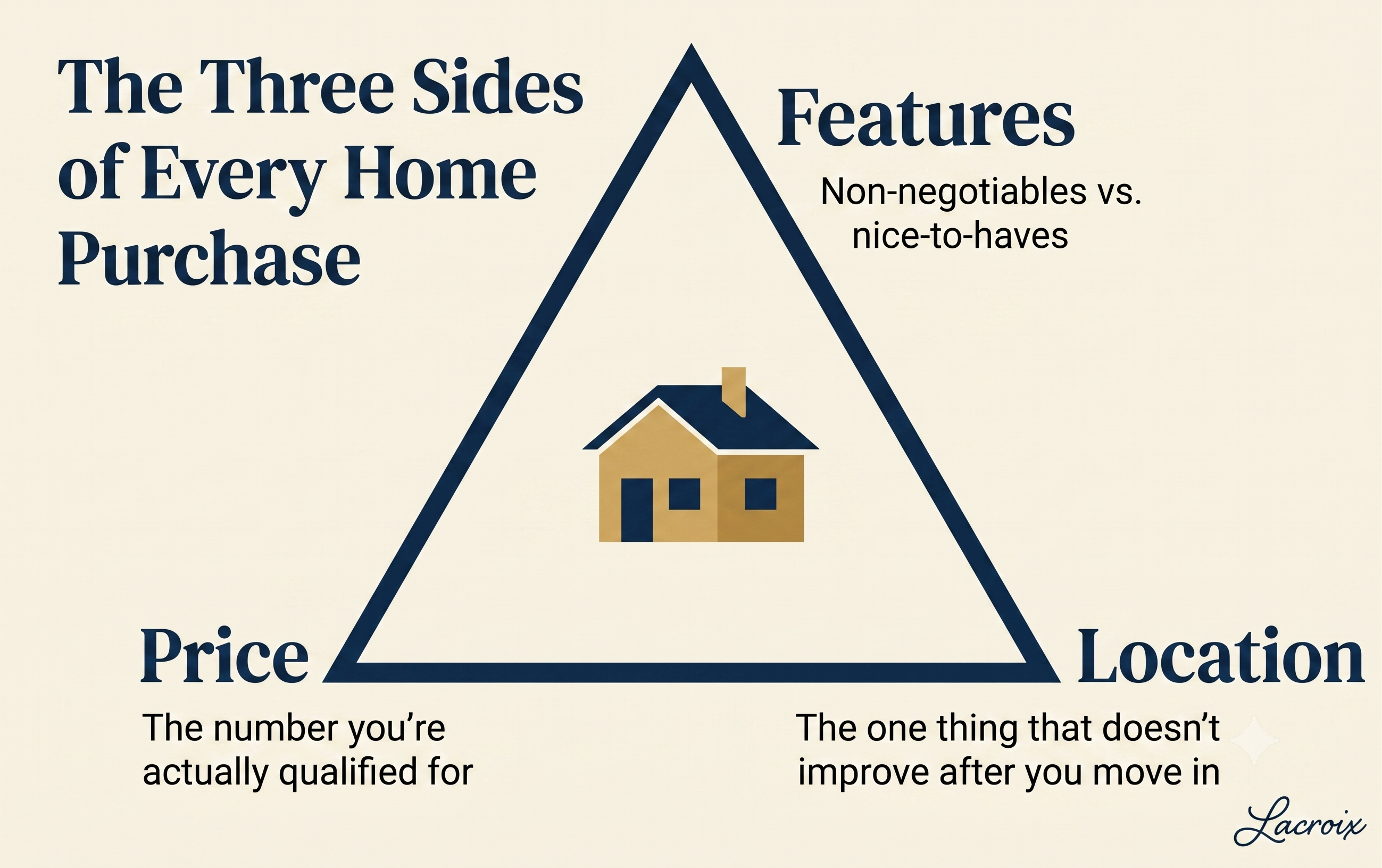
There is no such thing as a perfect house. That’s a myth. Aim to find a home that meets 80% or more of your needs. Remember the three-sided triangle – price, location, and amenities. You can only fulfill two sides of the triangle. So, decide what’s a priority and be flexible on the rest.

It’s Normal to Second-Guess Your Decision

Buying a home is a big deal. It’s entirely natural to second-guess your decision. Just know that an investment in real estate is an investment in your future. So, no matter what house you purchase, it’s a good decision. And if you decide in a few years to sell your home and move again, you can do that, too. You will have built equity.

Don’t Forget Why You Wanted to Buy a Home

It’s easy to get caught up in everything during a homebuying transaction. It can be overwhelming. Take a break and remember why you wanted to buy a home in the first place. You have dreams you want to pursue – start a family, build a business, generate familial wealth, be near better schools for your kids, open more opportunities, etc. Go back to those reasons and focus on them.

What were these buyers thinking in the above survey of over 5,000 buyers? Adding up 28.17% + 44.17% equals 72.34%, or 3/4 of their worries! If you take that 72.34% and add the 9.67% of finding a good Realtor, we now have 82.01% of worries.

We at The Envelope Real Estate Group are not magicians, miracle workers, or able to walk on water. However, we can eliminate 82% or more of your worries—I guarantee it!

This Home Buyers Guide London provides a brief overview of the home-buying process. However, spending hundreds of thousands of dollars, you deserve more than a brief overview!

If You Were Involved in This Survey, What Would You Worry About Most in Buying a Home?

Home Buyer 101

In a recent survey, 61.7% of home buyers stated they wished they knew what they know now and would be more diligent when buying a home in the future!

In one of the greatest financial books ever written, ‘The Richest Man in Babylon,’ George Clason writes that there are two kinds of study: the things we learned and knew and the training that taught us how to find out what we did not know. 

It is like a person complaining of a sore belly goes to their doctor and tells the physician that Dr. Google says it is blah blah blah! The kind physician ( the one not rolling their eyes or thinking, “Oh no, here we go again) will ask questions, identify the cause or the remedy and treat the problem.

The same happens; wise, intelligent people listen to what their neighbour or co-worker says, read “how to save thousands when buying real estate, “or watch all those reality shows and then become experts in buying a home.

Home sellers and their real estate representatives love you because you are the one who overpays for a home (yet brags that you got a good deal, yadayadayaa) or finds out that the house has structural issues or a neighbourhood stigma.

It’s like losing weight; it’s easier to buy bigger pants!

Shopping For a Home in London, Ontario and the area?

You Have Choices

Offering a Price Without The Correct Comparisons

What price do you offer a seller? Is the seller’s asking price too high? Is it ideal? Without research on the market and comparable homes, you are bidding blind.

A professional Realtor who represents you should offer an unbiased opinion on a home’s value based on market conditions and the home and neighbourhood conditions.  I said they should, but how would you know if it is unbiased, what comparables are used, and in what time frames?

Without this knowledge, you could quickly bid too much or miss out on a great buy.

The right home.

What are you looking for in a home? It’s a simple enough question, but the answer can be complicated. More than one buyer has been swept up in the emotion and excitement of the buying process only to find themselves the owner of a home that is either too big or too small.

Perhaps they didn’t consider the drive to work, the distance to school or the many fix-ups they want to deal with now that the excitement has died.

Take the time now to define your wants and needs, discuss them with your Realtor, put them in writing, and use them as a yardstick to measure every home you visit.

Unclear title

Before you sign any documents, be sure the property you are considering is free of all encumbrances. Your lawyer will do this for you as part of their fiduciary duty, but please ensure your Realtor includes clauses to protect you.

The last thing you want to discover before you move in is tax liens, debts, undisclosed owners, leases, contracts or easements. Most lenders will only issue a mortgage with a survey or title insurance, and real estate lawyers tell me that 99% of their transactions involve title insurance.

Unexpected repairs

Don’t expect every seller to disclose every physical detail that requires attention. Use a professional home inspector to inspect the home thoroughly before you close. A good Realtor will include a home inspection clause in the offer, and you would only fulfill this condition if the inspection report is suitable for you. 

(Get my free information: “The Role of a Home Inspector & What To Be Careful About”)

Unfortunately, anybody can call themselves a “Home Inspector,” but there is no Provincial Governing Body that monitors and ensures credentials. Over the years, I have seen some doozies, unbelievable, erroneous, and great reports.

Not Getting Mortgage Pre-approval

Knowing what you qualify for beforehand will help you avoid disappointment. Shopping for a home will give you more power; the seller will consider your offer seriously.  Did you know that shopping for the best rate and terms could save you $50,000 or more over 20 years?

Note: Be careful with pre-approvals. Not all pre-approvals are the same.

Hidden Costs

There may be some costs or fees you have yet to think about. A good Realtor will discuss this with you, and you should consult with your lender, lawyer and any other professional about all fees and costs.

Rushing the Closing

Take your time during this critical part of the process.

  • Do you understand your mortgage details?
  • Has anything been forgotten?
  • Do the paperwork and documentation reflect your understanding of the transaction?

Will your Realtor take you through your planned house 2 to 3 days before closing? (This will ensure that no unusual changes in the home’s condition are supposed to stay.)

Plan for Flexibility

Allow for contingencies and have a backup plan. If you or the sellers need more time to conclude the final arrangements, keep these delays from upsetting or frustrating you.

If it’s not in Writing, It Doesn’t Exist.

Don’t make any assumptions or believe any assurances.  Keep an ongoing log (in writing) of all discussions and get the seller’s written approval for all agreements.

How long do you plan to live in the home?

Buying & selling a home in London or anywhere, in fact, can cost money.  If you have to move in the short term, the value of your home may not have appreciated enough to cover the costs of buying and selling.  The time it takes to cover those costs depends on various economic factors. What features do you require in a home to satisfy your lifestyle now?

Five years from now?

People tend to remain in homes longer than they initially intended, primarily due to the work and expense associated with moving.  Therefore, it is worth considering a home with room to grow. Could the basement be turned into a den and extra bedrooms? 

Your financial health – your credit and home affordability

Is now the right time financially for you to buy a home? Would you rate your financial picture as healthy? Do you think your credit is good? While you can always find a lender to lend you money, people with poor credit tend to pay far more to borrow.

Some say that you should refrain from borrowing as much as you qualify because it is wiser to maintain your financial boundaries. The other school of thought says you should try to buy as much home as you can afford because, with regular pay raises and increased earning potential, today’s big payment will seem like less of an amount tomorrow.

Where will the money for the transaction come from?

Homebuyers typically need some money for a down payment and closing costs. However, with today’s broad range of loan options, having a lot of money saved for a down payment is only sometimes necessary – if you can prove that you are an acceptable financial risk for a lender.

If your credit isn’t stellar, but you have saved 5-20% for a down payment, you may still appear to be an excellent financial risk to some lenders. High-ratio mortgages can be a good option for those who haven’t managed to save a large chunk of money (who has?), but naturally, these have additional costs.

The ongoing costs of homeownership.

Maintenance, improvements, taxes, and insurance will exceed your monthly house payment. A monthly homeowner’s association or maintenance fee will be required if you buy a condominium or townhouse. If these additional costs are a concern, you can lower or avoid these fees.

I left the best for last: Make sure you know what you want!

Knowing what you want may sound simple, but many homebuyers require a reality check before searching for a home. When you shop for a place to live, two homes compete for your attention: the one that meets your needs and fulfills your desires. Your goal is to find one home that does both!

When you look at homes, you may fall in love with one or another home for entirely different reasons. Is it better to buy the house with the large main bedroom with a large ensuite, the one with the large country kitchen, the one with a pool, or the one with a finished basement?

Far too often, people buy a home for the wrong reasons and then regret their decision when the house does not meet their needs.

Do not shop with stars in your eyes: satisfy your needs first

To help you know what you want:

What do I NEED in my next home?

1____________________________________________________________

2_____________________________________________________________

3_____________________________________________________________

4_____________________________________________________________

5_____________________________________________________________


What would I LOVE in my next home?

1_____________________________________________________________

2_____________________________________________________________

3_____________________________________________________________

4_____________________________________________________________

You’ve Made an Offer on a House, and It’s Been Accepted – Now What?

Do’s & Don’ts for Buyers.

This home purchase checklist in our Home Buyer’s Guide London, Ontario, contains the most common mistakes buyers make that create messy situations leading up to closing.

Don’t Buy a Car or New Furniture

It’s an exciting time to dream of living in your new home, with all new furniture, and driving that new car. But until the lender has fully vetted your finances, making big purchases can disrupt your debt-to-income ratio (DTI) and boot you out of qualifying for your home loan. Wait until you close on your home before going shopping.

Don’t Make Large Cash Deposits or Move Money Around

Don’t mislead your lender when they ask about your income, other sources of income, or anything that might affect your ability to qualify for your mortgage loan. Be upfront and honest.

Don’t Apply for Credit or Increase Your Limits

When the underwriters work on verifying your income and the ability to repay the loan, they take a snapshot of your financial situation. If you apply for additional credit or increase credit limits, you’re just throwing a wrench into their process.

Don’t Co-sign for Anyone

It doesn’t matter if it’s your brother or sister, aunt, cousin, or closest friend; don’t co-sign anything when qualifying for a mortgage. When you co-sign anything–from a rental application to a car note–you’re putting yourself on the hook for anything that might go wrong, which could kill your dreams of home ownership in a flash.

Don’t Get Behind on Your Payments

Qualifying for a home loan is no small thing, and it’s typically a longer process than many think. Now is not the time to skip a payment on your existing car note or your light bill. Those payments keep your credit score up.

Don’t Change Jobs or Careers

This is a big one, especially if you’re relocating. If you don’t need to change your job, wait until you close on your new home. You may need to change jobs if you’re moving to another city, but don’t do it while buying a new home.

Don’t Change Banks

Don’t change banks in the middle of qualifying for a loan. Your lenders don’t want to search for your money after they start working on your loan. If you’re not satisfied with your current bank, consider waiting until after closing on your home to switch to a different one.

Don’t Close Credit Cards or Max Them Out

Believe it or not, closing a credit card can negatively impact your credit score. For the same reason, don’t overuse your credit cards. Keep your credit usage to a maximum of 30% of your credit limit, and try to pay it off each month. Anything negatively impacting your credit score could cost you now and in the long run.


Do Save Enough Money for Closing

Set that money aside, and don’t spend it. Why? You will incur moving costs and unexpected incidentals that you may not have considered.

I have to admit it makes everything worthwhile when we receive these!

Buying a Home Isn’t About Luck-It’s About Strategy

Let’s talk about your next move — and how to make it happen.