London Ontario Real Estate. No Fluff. No Sales Pitch. Just the Truth.

 Written by Ty Lacroix — Real Estate Strategist & Broker, London Ontario 

RSS

What a Buyer Will Pay for Your London Home and What You Think It's Worth Are Two Different Numbers

Every London home sale begins at a kitchen table where a seller and their realtor decide on a price. That number — and the ten days that follow — determines everything. Not the market. Not the neighbourhood. The decision  made in that room.

Picture the moment.

You're sitting at your kitchen table with your realtor. You've lived in this home for twenty years. You know every corner of it. You've watched the neighbourhood change, watched similar homes sell, watched the market move up and then soften. You have a number in your head — the number that makes the next chapter of your life possible.

Your realtor has a number too. It came from the data — recent sales, days on market, what buyers in London are actually paying right now for a home like yours on a street like yours.

Sometimes those two numbers are the same. Often they aren't.

What happens in that room — and in the ten days after your home goes live — decides whether you walk away with what your home is worth, or whether you spend the next sixty days finding out the hard way that the market dHere's what nobody tells sellers before that kitchen table conversation:

A buyer has never seen your renovation receipts. They don't know what you paid for the Dacor range or the heated floors or the landscaping you spent three summers perfecting. They weren't there when you made those decisions, and they don't factor into what a buyer will offer on a Tuesday afternoon in London, Ontario.

What a buyer will pay is determined by one thing: what comparable homes on MLS sold for recently, filtered through how your home makes them feel when they walk through the door.

That's it. That's the entire equation.

The seller who understands this goes into those first ten days with a price that attracts buyers and a listing that makes them feel something. The seller who doesn't spend day 9 staring at a phone that isn't ringing, wondering what went wrong.

The first ten days are not like the rest of the listing period. Buyer attention in London peaks the moment a new listing appears. Realtors are watching. Buyers are watching. The first weekend generates the most showings your home will ever see.

A home priced at what a buyer will pay, with a listing description that makes someone think I can see myself living there — that home creates competition in the first weekend. Competition protects your price.

A home priced at what the seller hopes to get, described like every other listing on MLS — "3 bedrooms, 2 bathrooms, updated kitchen, must see" — generates silence. And silence by day 9 is expensive.

By day 10, the market has delivered its verdict. The question is whether you were ready to hear it on day one — at that kitchen table — or whether you're hearing it now, when your options are fewer, and the cost of waiting is already accumulating.

The best thing a great realtor does at that kitchen table isn't to tell you what you want to hear.

It shows you exactly what a buyer will pay — and then builds everything around protecting that number. The description, the photography, the timing, the pricing strategy. All of it is designed so that when the right buyer finds your home in that first weekend, they feel something strong enough to act on.

That feeling doesn't happen by accident. And it doesn't happen when the price and the presentation aren't working together from day one.

If you're thinking about selling in London and you haven't yet had that kitchen table conversation — the honest one, with real numbers — that's where it starts.

Talk to Ty About Your Home →

Why the First 10 Days Determine Your Sale Price →

Read

The Critical 10-Day Countdown: Maximize Your Home To Sell in London, Ontario

The journey of selling your home in London, Ontario, often feels like a long process, but the truth is, the success of your entire sale hinges on just a handful of critical days. In a competitive market, you don’t get a second chance to make a first impression. That’s why every seller needs to master the 10 most important days—from initial preparation to the final offer.

By focusing your effort, time, and resources on these key moments, you can significantly reduce your time on the market and secure the highest possible price for your property.

Days 1-5: The Strategic Preparation

These are the days when money is made. Buyers in London are looking for move-in-ready homes, and meticulous preparation pays off.

Day 1: The Valuation & Strategy Meeting. This is when you hire your Realtor. This is more than just getting a price estimate; it’s about creating a hyper-local strategy. Your Realtor should come prepared with:

  • A comparative market analysis (CMA) of recently sold properties in your neighbourhood.

  • A clear, data-driven pricing recommendation.

  • A detailed timeline of all necessary pre-listing activities (cleaning, staging, photography).

Day 2: Declutter, Depersonalize, and Repair. Buyers need to envision themselves in the space, not you. Spend this day ruthlessly removing personal items (photos, trophies, collections) and minimizing furniture. Perform small, high-impact repairs, such as fixing leaky faucets, patching holes in drywall, and replacing burnt-out light bulbs.

Day 3: Deep Cleaning and Staging. A professional deep clean is non-negotiable. Focus on kitchens (appliances, cabinets) and bathrooms. After cleaning, apply simple staging principles: fresh towels, organized pantries, and a clean, neutral aesthetic. Staging helps showcase the room’s potential and makes photos pop.

Day 4: Professional Photography & Video High-quality listing photos are your most powerful marketing tool. This is not the time for amateur phone pictures. Professional photos and a 3D virtual tour or video walkthrough are essential for capturing buyers who start their search online.

Day 5: Write the Compelling Listing Description. Work with your Realtor to craft a description that tells a story, highlights key features (e.g., proximity to parks, specific school zones, upgrades), and focuses on the emotional benefits of living in the home.

Days 6-9: The Critical Launch Period

The first week your home is on the market dictates the momentum of your sale. This is where demand is highest.

Day 6: The Official Launch (Go-Live Day). Your home is added to the London & St. Thomas Association of Realtors (LSTAR) MLS system. Every marketing element—photos, video, description—is flawless. All your Realtor’s pre-marketing efforts (social media previews, “coming soon” signs) pay off today.

Day 7 & 8: Showings and Open Houses. These days are designed for maximum visibility. The goal is to generate as many showings as possible. Keep the home immaculate, ensure all lights are on, and consider leaving for the day. An optional weekend open house can capture potential buyers who are not actively working with a Realtor.

Day 9: The Brutal Truth. There is no indication of any offers. Or, only one or a low-ball.

Day 10: The Negotiation and Acceptance

This is the day you convert interest into equity.

Day 10: Strategic Negotiation A strategic negotiation comes into play! This is not just about the highest price; it’s also about the best terms:

  • Closing Date: Does it align with your next move?

  • Conditions: Are the offers firm (no financing or inspection conditions)?

  • Deposit: Is the deposit substantial?

Your Realtor’s negotiation skills and financial integrity are paramount in ensuring you get the maximum value while protecting you from contingencies.

The Takeaway

The bulk of your effort needs to be front-loaded. But here's what this page doesn't tell you: the sequence matters as much as the steps. Most London sellers do all ten things — in the wrong order. That single mistake is what separates a sale in 10 days from a home that sits for 60.

There are three specific decisions made in Days 1 and 2 that determine everything that follows. Most realtors don't raise them. Most sellers don't know how to ask.

If you're thinking about selling in the next 6 months, it costs nothing to find out where your home stands right now.

WHAT WOULD YOUR HOME SELL FOR IN THIS MARKET?

Read

The Quiet Deadline Nobody Talks About When You're Thinking of Downsizing in London

There's a window of time when downsizing is entirely your decision. Most London homeowners don't realize how narrow that window is — or that waiting too long means someone else will make the call for them.

Nobody sits down and decides to let someone else control one of the biggest financial moves of their life.

It happens gradually. A health change. A fall. A diagnosis. A family meeting that starts with concern and ends with a timeline you didn't choose. Suddenly, the conversation isn't if you move — it's when, and the answer is soon, and the person driving that answer isn't you.

After 24 years of helping people to downsize,  I've sat across the table from both kinds of homeowners. The ones who planned early and moved on their terms. And the ones who waited, for reasons that made sense at the time, until the decision was no longer fully theirs to make.

The difference in outcome — financial and emotional — is not small.

The window is real, and it closes

There is a period in most homeowners' lives when all of the conditions for a good transition align: you are healthy enough to manage the process, your home is in good condition, the market is workable, and you have the mental bandwidth to make deliberate decisions.

That window doesn't announce itself. It doesn't send a calendar invite. It's just there — and then, at some point, it isn't.

According to Statistics Canada, the average Canadian homeowner over 65 who sells under unplanned circumstances — a health event, family pressure, estate situation — receives measurably less for their home than those who sell on a self-directed timeline. The stress of the situation compresses the process, and compressed processes almost always favour the buyer, not the seller.

In the London market specifically, homes that sit while families sort out logistics tend to present poorly. Deferred maintenance becomes visible. Motivated-seller signals leak into negotiations. Buyers notice.

What "waiting to see" actually costs

I hear this regularly: "We're not ready yet. We'll know when it's time."

That's not a plan. That's a hope.

The homeowners who move well are almost never the ones who timed the market perfectly. They're the ones who made the decision while they still had full control over every part of it — the price, the pace, the next home, the moving date, what stays and what goes.

A 2023 Royal LePage study found that Canadian homeowners who engaged a real estate advisor more than 90 days before listing sold for an average of 3.2% more on their final sale price. On a $750,000 London home, that's $24,000 — simply from having time to make good decisions instead of fast ones.

But the financial gap is only part of it. The homeowners who plan early also get to choose their next home thoughtfully. They're not buying under pressure. They're not settling for whatever is available the week they need to move. They find the right bungalow, the right condo, the right neighbourhood — because they had the time to look.

The conversation nobody wants to have — until they wish they'd had it sooner

I'm not writing this to create urgency for its own sake. I have no interest in pushing anyone into a move before they're ready.

What I am saying is this: there is a version of this transition that is calm, well-sequenced, and entirely on your terms. And there is a version that is reactive, rushed, and shaped by circumstances outside your control.

The only thing that separates those two versions is when you start the conversation.

Not the listing. Not the moving truck. Just a private, honest conversation about where you are, what your home is realistically worth right now in the London market, and what a move on your timeline would actually look like.

That conversation takes about 30 minutes. It costs nothing. And for most of the homeowners I've worked with, it's the moment the whole thing stopped feeling overwhelming and started feeling manageable.

If you've been thinking about this — even quietly, even just in the back of your mind — this is the right time to talk. Not because the market demands it. Because you still get to decide.

Fill out the form at enveloperealestate.com/downsizing-your-home-london-ontario.html or call me directly at 519-435-1600.

Read

Why Most Downsizing Moves in London Cost Homeowners More Than They Realize — And How to Protect Yourself

Most London homeowners who downsize without a written plan end up leaving money on the table — sometimes tens of thousands. This post explains the three decisions that determine whether your move protects your equity or quietly erodes it.

You've owned your home for a long time. You've maintained it, paid it off or nearly so, and watched it grow in value. Now you're starting to wonder: Is this the right time to make a move to something smaller?

That's a reasonable question. What most people don't know is how you answer it — and who helps you — determines whether you protect what you've built or give a meaningful chunk of it away.

Here's what I see after 24 years and 1,383 closed transactions in London: the homeowners who make this transition well almost always do two things early. The homeowners who don't almost always do the same two things late.

The decision that seems small but isn't: timing

Most people believe that spring is the best time to sell. It often is. But the more important timing question isn't about the season — it's about your own circumstances.

A 2023 Royal LePage study found that Canadian homeowners who engaged a real estate advisor more than 90 days before listing achieved an average of 3.2% higher final sale price. On a $750,000 London home, that's $24,000. Not because they did anything dramatically different. Because they had time to make deliberate choices instead of reactive ones.

When you move under pressure — health change, family push, lease expiry on a condo you already bought — your negotiating position weakens. Buyers can sense urgency, and they use it.

The right time to plan a downsizing move is before you feel you have to.

The mistake that's almost invisible: pricing your home to win your own confidence, not the market

There's something I see regularly that I want to be direct about.

Many realtors will tell you what you want to hear about your home's value. A high number feels good. It can also quietly cost you weeks on the market, multiple price reductions, and a final sale well below what a properly priced home would have achieved from day one.

Here's the data: the London market average for sale-to-asking price ratio is 97.2%. Our clients close at an average of 99.2% of list price. On a $900,000 home, that 2% difference is approximately $18,000 — real money, not a rounding error.

That spread doesn't come from luck or aggressive marketing. It comes from accurate pricing at the start, based on what London buyers are paying right now — not six months ago, and not what your neighbour believes his house is worth.

The part nobody warns you about: what happens between accepted offer and moving day

This is where most transactions quietly unravel.

The paperwork is signed. Now you need to:

  • Coordinate closing dates on two properties

  • Decide what's coming with you and what isn't — 30, 40, sometimes 50 years of accumulation

  • Manage the logistics of an actual physical move

  • Handle utility transfers, walkthroughs, and key exchanges

For most homeowners, this part is more stressful than the sale itself. And most realtors hand you a business card for a moving company and consider their job done.

I don't operate that way. But here's the thing — I can't explain in a blog post exactly how that part of the process works for your specific situation, because it depends entirely on the details: your timeline, your health considerations, your family dynamics, your financial picture.

What I can tell you is that there's a specific order to these decisions, and getting that order right is the difference between a transition that feels managed and one that feels like it's managing you.

One number worth knowing before you do anything else

According to the Canadian Real Estate Association, homeowners who downsize without a written transition plan are significantly more likely to accept a below-market offer — often under time or family pressure. That's money you earned over decades. It doesn't come back.

Before you talk to any realtor, before you go to an open house, before you call your bank — there is one conversation worth having. It takes about 30 minutes. No forms to sign, no pressure, no follow-up unless you want it.

It's a private conversation about where you are, what your home is realistically worth right now, and what a transition on your terms actually looks like.

If your home is worth $700,000 or more and you're thinking about this — even 12 months from now — this is the right time to talk.

Fill out the form at enveloperealestate.com/downsizing-your-home-london-ontario.html or call me directly at 519-435-1600. Tell me where you are in your thinking, and I'll give you a straight answer.

Read

Why London's Real Estate Headlines Are Costing You Money

City-wide real estate statistics are fundamentally misleading for established homeowners in London, Ontario. Navigating a successful asset transition requires hyper-local market math, as homes priced and marketed with neighbourhood-specific precision retain up to 5.5% more equity than those relying on a generalist, city-wide approach.

The Danger of the "Average" Market. If you are reading the headlines about the London real estate market in 2026, you are likely seeing a lot of generalized averages. The problem is that navigating the sale of an established home using an "average" strategy is a significant financial risk. London is not a single market; it is a collection of distinct micro-economies. In fact, current data models show that average sale prices can vary by over $330,000 between postal codes that are just minutes apart. Treating a historic property in Old South the same as a newer build in Fox Hollow leaves money on the table.

Equity Protection Requires Precision. When it comes time for an asset transition, your primary goal should be protecting the wealth you have built in your home. Relying on a blanket marketing approach rarely achieves this. Industry metrics indicate that properties relying on generic, wide-net marketing plans average 18 days longer on the market, which increases the statistical risk of subsequent price drops by 22%. Your home's value is dictated by its specific geographic advantages—such as school feeder patterns or walkability—and your strategy must reflect those advantages.

Moving Safely and Strategically: Making the choice to transition your equity into a space that better fits your current lifestyle should not be overwhelming. However, a recent survey revealed that 68% of established homeowners cite "pricing uncertainty" as their primary stressor when considering a move.

You do not have to guess. By acting as your real estate Strategist and Realtor, I track the exact, hyper-local math in your specific neighbourhood. If you are preparing for a move, we will focus strictly on the data that matters to your street, ensuring your equity is protected and your transition is handled with absolute care.

Here is a link to my Riverbend London Neighbourhood page, which includes the latest real estate data. A new client contacted me, and as we broke down her home, the amenities and street location, we identified the correct price and how to market her home. It worked! 5 days and full price!

Don’t Depend on Average, It will Cost You!

Read

The "Wait and See" Trap: Why Standard Pricing Strategies Are Costing London Home Sellers Their Equity

In the current London, Ontario real estate market, hope is not a strategy.

During the frenzied peaks of the past few years, you could put a sign in the lawn, drastically overprice a home, and still walk away with a premium outcome. The market forgave mistakes. Today, the market is highly analytical, and it punishes guesswork with lost equity.

The most dangerous phrase a home seller can use right now is, "Let's just price it a little high to leave room for negotiation, and wait and see what happens." I call this the "Wait and See Trap," and it is the fastest way to leave tens of thousands of dollars on the table.

The Anatomy of a Stale Listing

When you price a property 5% to 10% above its actual data-driven market value, you aren't leaving room for negotiation; you are actively repelling your best buyers.

Today's buyers are heavily educated. They have access to the same historical sold data that real estate agents do. When a new listing hits the market, they instantly know if it is priced correctly. If it is overpriced, they don't submit a lower offer—they simply ignore it.

Here is exactly how the "Wait and See" timeline usually plays out:

  • Days 1–14: The house gets a few showings, but no offers. The seller assumes buyers are just taking their time.

  • Days 15–30: Showings stop completely. The listing becomes "stale." The algorithm stops pushing it to the top of search results.

  • Day 31: The agent suggests a price reduction.

  • Day 35: The price drops. But instead of attracting eager buyers, there is now blood in the water. Buyers see a home sitting on the market with a slashed price and immediately ask, "What is wrong with it?" or "How desperate are they?"

By starting too high, the seller usually ends up accepting an offer below what the true market value was on Day 1. They lost their leverage, their momentum, and their equity.

Engineering a Premium Outcome

Protecting your wealth during a real estate transition requires precision, not a fishing expedition.

A high-performance sale relies on analyzing localized absorption rates in your specific London neighbourhood, understanding exactly who your target demographic is, and utilizing a pricing strategy that acts as a magnet to create competitive urgency on opening weekend.

Setting the right asking price the first time isn't a guessing game; it is a calculated financial strategy.

Zero Barriers to Entry

Most Realtors treat their market knowledge like a trade secret, only revealing it after you sign a listing contract. I believe the opposite. I believe the more you understand the mechanics of a high-performance sale, the more you will value a high-production partner.

Pricing strategy is just one of the variables required to protect your equity. From transition sequencing to identifying the 101 specific micro-upgrades that actually yield a return on investment, you need a complete roadmap.

I have compiled my exact fiduciary methods into six proprietary playbooks.

You don't need to sign a contract to read them. I have made them entirely accessible.

[Click here to instantly unlock your All-Access Pass to The Home Seller's Intelligence Library.]

Read

Beyond the Yard Sign: Why "Standard" Real Estate is Costing London Homeowners Thousands

In a shifting market, there is a wide gap between listing a home and selling it.

For years, the London real estate market has relied on a "post and pray" model: a sign in the yard, a few photos on the MLS®, and a hope that the right buyer happens to be scrolling that day. But for the modern homeowner, "good enough" marketing is a quiet tax on your equity. If you want a result that outperforms the neighbourhood average, why not a strategy that moves beyond the status quo?

Stopping the 1.5-Second Scroll

In today’s digital-first environment, your home has approximately 1.5 seconds to capture a buyer's attention before they move on. High-quality visuals are no longer a "perk"—they are the frontline of your home's value.

My framework uses high-end architectural photography and cinematic video to tell a story. We aren't just showing rooms; we are manufacturing an emotional response. By leveraging drone intelligence and immersive virtual tours, we ensure that out-of-town buyers and local prospects alike feel the flow of your home before they ever set foot on the property.

Digital Omnipresence: Finding the Buyer, Not the "Like"

Most agents think "online marketing" is a one-time Facebook post. I view it as a high-velocity engine. Through Digital Omnipresence, we utilize sophisticated behavioural targeting to find buyers based on their actual search patterns—not just demographics.

  • Behavioural Targeting: We place your home directly in front of people actively searching for London real estate.

  • Omni-Channel Execution: Your property follows qualified buyers across social sites, Google, and dedicated web platforms.

  • Retargeting Loops: If a serious buyer views your home once, we ensure they see it again, keeping your property top of mind until they take action.

The Engine of Exposure

The MLS® is the baseline, not the finish line. To truly dominate the market, we launch a multi-channel campaign:

  • Precision Email Strikes: We leverage a curated database of high-intent buyers and the city’s top-performing Realtors® to put your home in the right inboxes.

  • Global Syndication: We syndicate your listing across major portals to reach GTA and out-of-province seekers of London opportunities.

Your Equity Deserves a Strategy, Not a Checklist

The difference between a "sold" sign and a record-breaking result lies in the data and execution behind the scenes. I work with London homeowners who recognize that their homes are high-stakes investments that require a producer's touch.

My approach is backed by real-time analytics and a relentless focus on maximizing your impact. We don't wait for the market to move; we command its attention.

Stop guessing what your home is worth. Let’s discuss how a high-performance marketing strategy can protect your equity.

Read

The London Homeowner’s Dilemma: When the Family House Becomes a Part-Time Job

Protecting Your Equity and Your Peace of Mind in a Changing 2026 Market

You look around the home where you raised your family. Every corner holds a memory: the marks on the doorframe measuring growing children, the backyard that hosted decades of barbecues. It is not just a house; it is the vessel of your family’s history.

But lately, the house feels different.

Perhaps it’s the two spare bedrooms that haven't been used in months. Maybe it’s the daunting realization that the roof needs replacing, or the garden is becoming too much to manage on a hot London afternoon. What was once a sanctuary can slowly transform into a burden—a part-time job you never applied for.

If you are considering downsizing in London, Ontario, you are likely facing two distinct challenges: the emotional weight of leaving a legacy and the financial complexity of selling a high-value asset in a shifting market.

Moving Beyond the Standard "Sales" Transaction

In 2026, selling a long-held family home is no longer a simple real estate transaction; it is a significant Asset Management decision. The equity you have built over twenty or thirty years is the foundation of your future security.

Unfortunately, the standard "transactional" approach often fails homeowners in your position. A typical focus on a "quick sale" does not account for the intricate planning required to move decades of belongings, align timelines with your next residence, and ensure your financial interests come before a quick commission.

You do not need a salesperson pushing you to list before you are ready. You need a Strategic Fiduciary Advisor—a partner who places your long-term security and equity protection above all else.

A Strategic Plan for Your Next Chapter

A professional transition strategy turns an overwhelming mountain of tasks into a manageable, predictable process. It begins not with a yard sign, but with a high-level conversation about your goals.

Having recently guided families in neighbourhoods like Byron through these exact transitions, I’ve seen firsthand how a strategic market position can maximize a sale while minimizing the emotional toll. We address the critical questions: How do we protect your hard-earned equity? What is the realistic timeline for a dignified exit from a legacy asset?

By focusing on a structured plan rather than just a sales pitch, we reduce the stress of the unknown. You deserve to move forward with clarity and confidence, knowing your legacy is being handled with the respect and professional care it deserves.

Are you starting to feel overwhelmed by the thought of downsizing? Let’s have a private, no-obligation conversation about your options. We will discuss a timeline that works for you, not against you.

Contact me today to begin planning your strategic transition.

Read

Why Waiting Until Spring Could Cost You Thousands

In the London, Ontario real estate market, there is a long-standing tradition: wait for the Spring. Many buyers and sellers believe that the "Spring Market" is the gold standard for moving, assuming that more options and more buyers automatically lead to a better result.

However, as we move into January and February, the data suggest that the "wait-and-see" approach may be the most expensive strategy you could choose this year. Here is why the early winter market is currently offering opportunities that the spring rush likely won’t.

For Sellers: Beating the "Inventory Flood" and “The Hidden Cost of Competition”

In a buyer’s market, supply already outweighs demand. When the spring market begins, London typically sees a surge in new listings. If you wait until then, you aren't just competing with the current inventory—you are competing with a flood of "fresh" listings that can further dilute the pool of available buyers.

  • The Competition Factor: Right now, there are fewer homes for buyers to choose from than there will be in two months. By listing now, you position your home as a primary option rather than one of dozens in a saturated spring market.

  • Serious Motivation: The buyers active in January and February are typically motivated by necessity (relocation, family changes, or expiring pre-approvals). They are ready to make decisions, whereas spring buyers often include "looky-loos" who may not be ready to sign.

For Buyers: Beating the "Price Creep" and Interest Shifts

For buyers, the cost of waiting isn't just the home's price; it's the cost of the money.

  • Mortgage Rate Stability: The Bank of Canada has held rates at 2.25%, providing a window of predictability. However, many analysts suggest that as the economy continues to adjust to shifts in trade and migration, we could see a "rate floor." Waiting until spring means you might be competing with a flood of other buyers, potentially driving prices up by 2% to 4%—a "spring premium" that can easily amount to $15,000–$25,000 on an average London home.

  • Negotiation Power: In the winter, you often deal with highly motivated sellers. In the spring, sellers are often more rigid, expecting multiple offers and "bidding war" conditions that may not materialize, but still make the negotiation process more difficult for you.

The Bottom Line

While each year has its own economic drivers, London has shown a consistent seasonal pattern: average sale prices often rise as the market transitions from the quiet of January to the peak of May. Even in years where the market felt "slow," the cost of waiting for warmer weather was high.

The London market in 2026 is defined by preparation over speed. Whether you are looking to downsize, upgrade, or relocate, the current "quiet" market offers a level of control that the spring frenzy often erodes.

Deciding when to move is a personal choice, but it should be based on your specific goals rather than a calendar date. Sometimes, the best time to act is when everyone else is still waiting for the snow to melt.

What is your market position in London, Ontario?

Read

Before You Make a Move in 2026

The London Ontario real estate market heading into 2026 is not a repeat of the last few years — and it’s not as simple as the headlines make it sound.

What I’m seeing consistently is that many people are making decisions based on outdated assumptions rather than current conditions.

Whether you’re thinking about selling, buying, relocating, or just researching your options, the gap between perception and reality has widened. And that gap is where costly mistakes tend to happen.

This isn’t about predicting the market.
It’s about understanding how it’s actually behaving now — and what that means before you make a move.

What’s Changed (and What Hasn’t)

The market hasn’t “stopped,” but it has shifted.

  • Buyers are more selective, not absent

  • Pricing matters more than ever — accuracy beats optimism

  • Well-prepared properties still move

  • Poorly positioned ones sit and quietly lose leverage

The most significant change isn’t price alone — it’s alignment of expectations.
When expectations align with reality, transactions occur. When they don’t, frustration follows.

a shifted real estate market in London Ontario

If You Own a Home: This Is About Risk, Not Pressure

For homeowners, the most significant risk in 2026 isn’t necessarily timing — it’s mispricing and misreading buyer behaviour.

Some key considerations:

  • Overpricing no longer “tests the market” — it often removes momentum

  • First impressions matter more when buyers are cautious

  • Preparation and positioning can matter more than the list date itself

This doesn’t mean everyone should sell.
It means decisions should be based on current conditions, not last year’s results.

Clarity reduces risk. Assumptions increase it.

If You’re Planning to Buy: Strategy Matters More Than Speed

For buyers—especially those in the mid- to upper price ranges or relocating—the market still offers opportunities, but it rewards preparation.

What I’m seeing:

  • Competition still exists for quality homes

  • Price discipline matters more than urgency

  • Buyers who understand their position move with confidence

  • Buyers relying on outdated narratives hesitate or overreact

The strongest buyers in 2026 aren’t the fastest — they’re the most informed.

Why “Clarity First” Beats Pressure Every Time

The goal right now isn’t to push decisions. It’s to replace assumptions with clarity.

That’s why I’ve built a market position review designed to help people understand where they stand — whether they’re considering a sale, planning a purchase, or simply gathering information.

There’s:

  • No instant valuation

  • No sales pressure

  • No obligation

Just a clear look at what current conditions mean for your situation.

Take Five Minutes for Clarity

If you’re planning a move in the next 3–12 months — or even just exploring options — a clearer picture now can save time, stress, and costly missteps later.

👉 See what this means for your situation

Whether you move forward or not, you’ll walk away with better information — and better information leads to better decisions.

Read

Thinking of Downsizing in 2026?

If you’ve been saying, “This is the year we simplify,” you’re not alone. 2026 may be the perfect moment for smart downsizers to trade maintenance for freedom, stairs for convenience, and uncertainty for a clear, calm plan. And few cities deliver the blend of value, healthcare access, parks, and big-city amenities like London, Ontario.

Here’s the truth: downsizing isn’t just a smaller house. It’s a better life design—and the best results come from timing, pricing, and preparation that work together (not guesswork or pressure). That’s exactly what I help homeowners do: sell smart, buy right, and move on your schedule with fewer variables and less stress.

Why London works for downsizers

  • Choice: one-floor bungalows, townhomes with main-floor primaries, and well-managed condos across London and the surrounding area.

  • Care & connection: hospitals, specialists, and community hubs that make “lock-and-leave” living feel effortless.

  • Value: more home (or more cash in the bank) compared with the GTA—without giving up culture, dining, or green space.

How my 3-step Downsizing Program keeps things calm

  1. Discovery & Strategy – We clarify goals, timing, and the numbers. You’ll see a market snapshot and choose the right pricing strategy (in line with, ahead of, or behind the market).

  2. Right-Size Plan – We prep for impact (not waste), then shortlist the best condo/bungalow options that match your must-haves.

  3. Sell & Secure – Launch with precision, negotiate with confidence, and coordinate closing so your life—not your stuff—drives the timeline.

Ready to move from “someday” to done well? Start with my clear, no-pressure guide and page here: Downsizing Your Home in London, Ontario

On that page, you’ll find:

  • A free London Downsizing Playbook (PDF)—timelines, checklists, and sell-first vs. buy-first scenarios.

  • The market snapshot request—real numbers in plain language so you can plan with confidence.

  • A 20-minute consult—no sales pitch, just clarity and next steps that protect your equity and your sleep.

If 2026 is your year to right-size, let’s make it the year you do it calmly and confidently. I’m Ty Lacroix, a London broker who has helped hundreds of families move forward without the drama. Visit the page, grab the playbook, and let’s map your best path home.

Read

Deciding on a Price To List Your For Sale in London Ontario?

Deciding on a price to list your home for sale in London Ontario is one of the most crucial decisions you must make!  I wrote about the four core ingredients in selling a home in a previous blog. Below are some bullet points; though brief, they matter!

The Benefits Of Proper Pricing

A Quicker Sale! The right price leads to a faster sale, saving you on mortgage payments, real estate taxes, insurance, and other carrying costs.

Less Inconvenience: Preparing your home for showings and maintaining a clean property. Making arrangements for children and pets, and generally altering your lifestyle, takes time and energy. Proper pricing shortens market time.

Increased Buyer Representatives:   When salespeople are excited about a property and its price, they make special efforts to contact all potential buyers and show the property as soon as possible.

More Qualified Buyers: Pricing your home at market value will attract more qualified buyers. They have been pre-approved by a bank for a certain amount.

Higher Marketing Exposure: Buyer inquiry calls are more readily converted into showings when price is not a deterrent. Why? Home buyers know pricing; if your price is unreasonable, they won’t even look at the MLS listing.

Potentially Higher Offers. Buyers are much less likely to make a low offer when a property is priced right. Why? The fear of missing out!

The Drawbacks of Pricing a Home Too High

Less Activity: Realtors and their buyers will not visit the property if they feel the price is out of range to others on the market.

Lower Marketing Response: Buyer excitement will be directed toward other properties that offer better value.

Loss of Qualified Buyers: The property will appear to offer fewer amenities than comparably priced properties in the same price range.

Attracts the Wrong Buyer: Serious, qualified buyers will feel they should get more for their money.

Helps The Competition: The high price makes the other homes for sale look like a bargain!

The Elimination of Offers: A fair-priced offer will be lower than the asking price. Some buyers and their representatives do not want to insult the seller. Yes, buyers also have feelings! And a heart!

Appraisal Problems? Appraisers base their value on what comparable properties have sold for.

Lower Net Proceeds: An overpriced property will eventually sell for less than if appropriately priced. Not to mention the extra carrying costs.

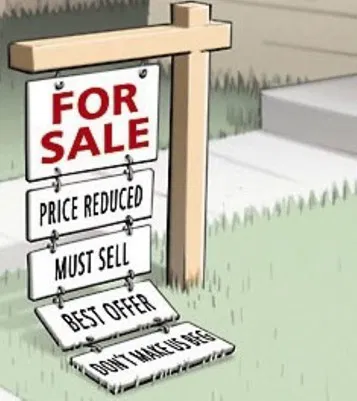
A sign you do not want when selling a house in London Ontario

A sign that shows that pricing a home inconsistently with the market is not good!

More Home Seller Tips

Read
Categories:   18 Tecumseh Ave E London Ontario | Apartment condos London for sale | Byron London Onario Real Estate Market | Byron London Ontario | Byron London Ontario Trends | Condo Buyer Tips | Condo Seller Tips | Downsizing Your Home | Downtown London Ontario Condos For Sale | Exurban Living | Foxhollow London Ontario Real Estate Market | Home Buyer Tips & Ideas | Home Seller Tips | Homes For Sale Hyde Park London Ontario | Homes For Sale Sunningdale London | House For Sale Oakridge London Ontario | House With Granny Suiite | Houses for sale Foxhollow London | Hyde Park London Ontario Real Estate Market | Income Property London Ontario | Investing in Real Estate | Kilworth Real Estate Market | Komoka Real Estate Market | Lambeth London Ontario | Lambeth London Ontario Real Estate Market | Lambeth London Real Estate Trends | London North Real Estate | London Ontario Neighbourhoods | London Ontario Real Estate Market | London Ontario Real Estate Numbers That Matter | London Ontario Real Estate Trends | London Real Estate | London Realtor Differences | London South Real Estate | Market Math London Ontario | Oakridge London Ontario Real Estate Trends | Old South London | Old South London Wortley Village | One-Floor House For Sale | Penthouse For Sale London Ontario | Real Estate Conundrums | Real Estate Executor | Real Estate Trends | Real Estate Trends Hyde Park London Ontario | Riverbend London Ontario Real Estate | Riverbend London Real Estate Market | Riverbend London Real Estate Math | Selling in Riverbend London Ontario | Sunningdale London Ontario Real Estate Market | Sunningdale London Real Estate Market Trends | Why Buy or Sell Byron London Ontario | Wortley Village
This website may only be used by consumers that have a bona fide interest in the purchase, sale, or lease of real estate of the type being offered via the website. The data relating to real estate on this website comes in part from the MLS® Reciprocity program of the PropTx MLS®. The data is deemed reliable but is not guaranteed to be accurate.