London Ontario Real Estate. No Fluff. No Sales Pitch. Just the Truth.

 Written by Ty Lacroix — Real Estate Strategist & Broker, London Ontario 

RSS

Who Decides The London Ontario Real Estate Market?

Who decides the London, Ontario real estate market? You do. Not the Bank of Canada, not the economists, not the spring market, not your neighbour. The market is the sum of individual decisions made by real people in real circumstances — and the best time to buy or sell is when your circumstances call for it, not when a headline says conditions are ideal. Ty Lacroix, Broker at The Envelope Real Estate Group, has lived through every market cycle in Southwestern Ontario over 24 years — and so have his clients.

Who decides the London, Ontario real estate market? Why? When?

The answer is simpler than most people expect — and more honest than most realtors will tell you.

You can study statistics, consult economists, listen to mortgage brokers, ask your relatives, or gaze into a crystal ball. All of that might give you useful context. None of it will tell you when you should buy or sell.

A Quick Theory Worth Knowing

Economist Hyman Minsky described a pattern that shows up in every economic cycle — real estate included:

When an economy is stable, people get optimistic. When people get optimistic, they take on debt. When they take on debt, the economy becomes unstable.

History doesn't repeat itself exactly, but people do. Since the beginning of recorded human behaviour, the cycle of optimism, overreach, and correction has played out in some form. Understanding that it exists — and that you're not immune to it — is the beginning of making a clear-headed decision.

The Best Time Is When You Want, Not When You Have To

Anyone who claims they can reliably time the real estate market should be walked politely to the door. Is spring the best time to sell? Summer? Fall? Winter? The honest answer: the best time is when your life calls for it — not when a seasonal narrative says it should be.

There are always outliers. Circumstances that override market timing entirely:

A job transfer between cities. A marriage ending. A death in the family. A genuine need to sell. Not needing a mortgage. Wanting to downsize before the decision gets made for you. Or simply being tired of ignoring a reality that's been quietly obvious for a while.

For every one of these, the "right time" is determined by life, not by what the market is doing. The market will be what it is. Your circumstances are what they are. The two don't always line up on a convenient schedule.

Full Disclosure

I am a realtor. I have been in this market long enough to have seen every cycle it can produce. There are things I know well. There are things I don't know at all. I am right-handed.

As you can see — I'm reasonably normal, aside from being a realtor. I try to keep my perspective on the London, Ontario real estate market grounded in reality rather than in whatever narrative is convenient for generating transactions.

I've lived through every market in Southwestern Ontario — the slow ones, the frantic ones, the corrections, and the COVID run that nobody expected and nobody should expect to see again. So have my clients. And the ones who made the best decisions weren't the ones who timed the market perfectly. They were the ones who understood their own situation clearly and made a decision that was right for their life — not for the market's mood.

A house or condo is brick and mortar. A home is you: your comfort zone, your reward at the end of the day. That's not a financial decision. It's a human one. The financial part is just what makes it possible.


Want a straight read on what the London market actually means for your specific situation right now? Reach out for a private conversation — no pressure, no pitch.

Read

What Homebuyers Want From a Realtor is Risk Management!

Most buyers think what they need from a realtor is access — to listings, to showings, to referrals for inspectors and lawyers. What they actually need is risk management: someone who helps them make a confident, informed decision, identifies what could go wrong before it does, and tells them the truth about what they're buying and what they're paying for it. After 24 years helping London buyers navigate this process, the pattern is consistent — the buyers who feel best about their decision afterward are the ones who understood the risks going in, not the ones who moved fastest. Ty Lacroix, Broker at The Envelope Real Estate Group, treats every buyer transaction as a risk management exercise — because that's what it actually is.

The most essential thing home buyers want from a realtor is risk management.

Arranging showings, referring mortgage providers, recommending home inspectors and lawyers — those are services. They're also basic responsibilities of the profession, not differentiators. Every realtor does them. Most buyers eventually figure out that what they actually needed was something more.

What Buyers Are Actually Thinking

Over 24 years and hundreds of buyer transactions in London, I've noticed that the questions buyers ask out loud are rarely the ones that matter most to them. The real concerns tend to sound more like this:

"Am I paying the right price for this home?"

"What if something major goes wrong with the place after I buy it?"

"Are the interest rate quotes from my bank good or bad — and is there something better?"

"What happens if in a year this doesn't work for my family?"

"What if I get transferred, or laid off, or my company changes direction?"

"I want to buy a place — but what about the down payment, the insurance, the inspection, the lawyer, the move? What am I missing?"

"Is this realtor transactional or genuinely looking out for me — and how do I tell before it's too late?"

Add your own concern here: ___________

Buying a home is an emotional experience for most people. It doesn't have to be a financial high-wire act. The difference between those two outcomes almost always comes down to whether the person guiding you treated the process as risk management — or as a transaction to close.

How I Define Risk Management for Buyers

Risk management in a real estate transaction isn't a phrase — it's a set of specific behaviours.

Listening before advising. Understanding what a buyer needs, what they want, what would be nice, and where their hard lines are — before forming any opinion about which home is right for them. Most realtors start with the listings. Risk management starts with the person.

Explaining reality with facts, not optimism. A buyer's buying power is what it is. The market is what it is. A home's condition is what it is. Telling a buyer what they want to hear is comfortable in the short term and expensive later. Telling them what's accurate — clearly, respectfully, without condescension — is what protects them.

Walking through the full process before any offer is written. This part is genuinely less exciting than driving around looking at properties. Buyers want to see homes — understandably. But a buyer who doesn't understand the process from offer to closing, including the what-ifs, will be stressed, surprised, and emotionally exhausted when something unexpected happens. And something always does.

The buyers who feel most confident after closing are almost never the ones who moved fastest. They're the ones who went in understanding what they were getting into — and had someone with them who had seen every version of what can go wrong, and knew how to prevent most of it.

If you're buying in London and you want that kind of representation — not access to listings, but genuine risk management — that's exactly the conversation worth having first.

[CTA block]
Ready to buy with confidence instead of anxiety? Reach out for a private conversation — no pressure, no pitch.

How Selling Your Home Actually Works in London Ontario

How Buying a Home in London Ontario Actually Works — From First Conversation to Keys in Hand

Read

What is Your Threshold Price For Buying a Home in London Ontario?

A threshold price is the number at which you can buy with confidence — knowing you paid a fair price and that if the market softens, your financial position won't be turned upside down. It's not the maximum you're approved for. It's not what you'd pay in a bidding war to avoid losing. It's the disciplined, data-backed ceiling you set before you walk into a showing and stick to after you fall in love with a home. Buyers who set a price threshold and hold to it consistently make better decisions than those who let fear of missing out make the decision for them. Ty Lacroix, Broker at The Envelope Real Estate Group, has helped London buyers set and hold their threshold price across every market cycle for 24 years.

What does a threshold price for buying a home actually mean — and why does it matter?

A threshold price is the number at which you can be confident you're paying a fair price for a specific home, in a specific neighbourhood, in today's specific market — and that if the market does take a downturn, your financial world won't be turned upside down.

It's not the same as your maximum approval. It's not the ceiling your bank set. It's the number you and your broker establish together, based on real comparable sales and an honest read of the market, before emotion enters the equation.

Where Discipline Pays Off

I've been in many offer situations over 24 years. Won some. And some where my clients didn't get the home — though I'd push back on the word "lost." You can't lose something you never had. When a client and I set a threshold price, and another buyer exceeded it by chasing the home rather than the value, my client didn't lose. They held their discipline and stayed protected.

Jim Rohn put it plainly: "The pain of discipline weighs ounces; the pain of regret weighs tons."

Not long ago, homes in London were receiving 7 to 15 offers, selling 12% to 18% above asking, with no conditions. The buyers who stretched beyond their threshold to win in that market — and then watched values correct — understand what Rohn meant in a way that's hard to forget.

The Fear of Missing Out Is the Biggest Threat to a Sound Decision

Fear of missing out (FOMO) is one of the most powerful forces in real estate decision-making, and it's almost always working against the buyer. It compresses timelines, inflates offers, and turns a considered financial decision into an emotional sprint.

Speculation compounds this. We read regularly about the small minority of buyers who timed the market perfectly and profited handsomely. We almost never hear about the much larger group who paid above value at the peak and spent years recovering the difference. Second and third-order consequences have a way of arriving quietly and staying a long time.

History doesn't repeat itself. People do.

The Right Frame for Any Purchase

I've adapted one of Warren Buffett's observations — replacing "stock" with "property" — and it holds up perfectly: it's far better to buy a wonderful property at a fair price than a fair property at a wonderful price.

The threshold price concept is exactly that in practice. The home has to be right, and the price has to be defensible — not just affordable, not just within approval, but genuinely fair given what comparable homes have sold for and what the market will likely support over the years you plan to own it.

If you're buying a home or condo in London and want a broker who will help you set your threshold price — and hold it when the moment gets emotional — that's exactly the kind of partnership worth having before you write your first offer.


Ready to buy with discipline instead of anxiety? Reach out for a private conversation — no pressure, no pitch.

For the complete buyer framework: How Buying a Home in London Ontario Actually Works — From First Conversation to Keys in Hand

Read

Be Flexible For Buyers To See Your Home in London, Ontario

When your home is for sale in London, Ontario, every showing request is an opportunity — and every declined or difficult showing is a potential sale that doesn't happen. Buyers are comparing multiple homes on tight schedules, often with limited time in the city. A seller who is inflexible, hostile, or simply unavailable hands the advantage directly to the next listing on the buyer's list. A $750,000 house in London sold for $709,900 — $40,100 less than asking — because the seller couldn't be bothered to keep the home show-ready. The math on flexibility is straightforward. Ty Lacroix, Broker at The Envelope Real Estate Group, has spent 24 years watching sellers win and lose offers based on decisions unrelated to price.

Being flexible for buyers to see your home in London, Ontario isn't a courtesy — it's a strategy.

Have you thought carefully about how and when buyers will be able to see your home? Because the moment a showing request comes in, that buyer is making their first real contact with your property — and how that experience goes sets the tone for everything that follows.

Make It Easy to Get In the Door

Wherever possible, schedule showings the way most homes in your area are shown — whether that's by appointment or through a lockbox system that allows buyer agents to book efficiently. The buyer viewing your home may be looking at multiple properties across a large area in a single afternoon. Their schedule is tight, their patience is finite, and the next home on their list is a few minutes away.

Make the buyer and their agent feel welcome. Be as flexible on timing as possible. And remember: if a qualified buyer is willing to spend hundreds of thousands of dollars on your home, the least you can do is be available when they want to see it.

Two Real Stories

An $879,900 home in London. The seller was too busy and couldn't keep the house tidy enough for showings. The result? The home sold one month later for $839,000. The $40,900 that disappeared wasn't taken by the market — it was given away by a seller who prioritized convenience over preparation.

Last weekend, my clients and I arrived at a scheduled showing at 11:55 AM for an 11:30 to noon window. The man in the house ranted that we were disrupting his day. We left without getting past the screen door.

That home had been on the market for 51 days. I wonder why.

What Buyers Are Actually Experiencing

Many buyers are reluctant to feel like they're intruding. The decision to buy a home is emotional and stressful — they're already anxious before they ring the doorbell. A hostile reception, a declined showing request, or a home that clearly wasn't prepared for them doesn't just lose the showing. It loses the buyer entirely, because there's always another home on the list that welcomed them.

Would you drive to a car dealership on a Thursday afternoon if you knew there was a chance they'd turn you away at the door? Would a family visiting London for the weekend have to reschedule around a seller who can't make time? Or would they simply buy somewhere else?

You don't have to go overboard. You don't have to rearrange your entire life around every showing. But be flexible — because that next buyer walking through your door could be the one who makes you an offer. And the one who walks away because you weren't ready might be too.

[CTA block]
Want to make sure your home is positioned to attract and keep the right buyer? Reach out for a private conversation — no pressure, no pitch.

For more home seller tips:
How Selling Your Home Actually Works in London Ontario

Read

Why Being Organized When Selling A London Home Is Vital!


The most critical time in selling a London, Ontario home isn't the negotiation — it's the 48 hours before your listing goes live. Errors in room sizes, missing photos, an inactive lockbox, a listing agent who doesn't return calls, or a home that appears on a sign before it appears on MLS can quietly cost you the buyers who were most motivated to see it. Research shows 94% of buyers preview homes online before visiting in person. If what they find online is wrong, incomplete, or absent — they move on. Ty Lacroix, Broker at The Envelope Real Estate Group, has spent 24 years ensuring none of this happens with his listings — because a disorganized launch is one of the most preventable ways to leave money on the table.

How organized is your listing before it goes live? Most sellers assume the hard work is pricing, preparing, and negotiating. The part that quietly costs the most happens earlier — before the sign goes up, before the first showing, before a single buyer clicks on your listing.

What Buyers Experience Before They Ever See Your Home

According to current data, 94% of buyers preview homes online before visiting in person. That means your listing's first impression isn't the front door — it's a screen, usually late at night, during the window of highest buyer interest and motivation.

If what they find online is wrong, incomplete, or missing — they move on. And in a market where buyers are comparing multiple homes simultaneously, they rarely come back.

The Failures That Happen Before You Know It

The sign goes up before the listing does. Buyers drive by, call the office, and get nowhere — because the listing hasn't been submitted yet. That first wave of interest, the highest you'll ever have, disappears before a single showing is booked.

The MLS entry is delayed. Buyers and their agents search daily for new listings, and their excitement peaks when something fresh appears. A one- or two-day delay means missing that window entirely.

The lockbox isn't active. A buyer and their agent arrive to find they can't get in. If they haven't made a purchase yet, they may reschedule once. They rarely reschedule twice.

Errors in the listing details. Wrong room sizes. Too few photos or poor ones. Last week, I showed an $839,000 home to clients who initially declined to see it because the photos were inadequate. Their interest was piqued after seeing it in person — but they didn't make an offer. The listing had already done its damage in the first impression.

Showing requests that go unreturned. The buyer's agent calls to book a showing. The listing agent doesn't call back. They try again. The window passes. The buyer moves on. This can happen two or three times before a motivated buyer simply gives up.

Unannounced showings — or showings that weren't supposed to happen. A buyer appears at your door without notice, or at a time you explicitly said wasn't available. The experience is uncomfortable for everyone and signals to the buyer that the process isn't being managed.

No feedback after showings. You don't know who viewed your home, what they thought, or what might be preventing an offer. The listing agent doesn't know either — because they didn't ask. Nothing gets adjusted. The pattern repeats.

What a Well-Organized Listing Looks Like

A properly managed listing launch means: the lockbox is professional-grade and active before the first showing. The MLS entry is accurate — room sizes, taxes, inclusions, square footage, all verified before it goes live. Photos are done properly, with enough of them, at their best. Showing instructions are clear, and the agent responds to requests the same day. Feedback from every showing is collected, recorded, and shared with you. And you, the seller, are always in the loop.

The listing agent's credibility transfers directly to your property. If the showing process is difficult, unresponsive, or disorganized, the buyer and their agent assume the transaction will be the same — and start wondering what else might go wrong.

The most critical moment in selling your London home is the 48 hours before it goes live on MLS. Everything that happens in those 48 hours determines whether your best buyers arrive at the right moment or miss you entirely.

The First 10 Days Your London Home Is on the Market Will Make or Break Your Sale.


Want to make sure your listing launch is done right the first time? Reach out for a private conversation — no pressure, no pitch.

See how the full selling process actually works: How Selling Your Home Actually Works in London, Ontario →

Read

Why Some London Ontario Apartment Condos Take Longer to Sell

Some London, Ontario apartment condos sit on the market for weeks while others in the same building sell quickly. The difference is almost never the unit itself. It's inaccurate listing data, unresponsive agents, incorrect condo fees, incorrect taxes, lockboxes with no unit numbers, and occupied units where nobody warned the occupant that a showing was booked. This is a true account of one Thursday of showings in a single London condo building — five units, five listing agents, and a set of problems that would have sent most buyers straight to the next building. Ty Lacroix, Broker at The Envelope Real Estate Group, has spent 24 years ensuring none of this happens with his listings.

I should warn you before you read further: my comments here are based on genuine frustration and exasperation. I don't suggest events like these will always repeat themselves. Can pigs fly?

My clients were interested in downsizing from their two-storey home and wanted to see two-bedroom units in a specific building — five units listed for sale, all priced within $35,000 of each other. We chose Thursday for viewings. I arranged showings Tuesday morning.

One agent replied within an hour — fine. Another responded the following day. A third confirmed that afternoon. Two didn't respond at all, so I called their offices and used our appointment scheduler. One called back immediately and apologized for forgetting to confirm. The other I never heard from. Three weeks later, that condo was still listed for sale.

Checking the Facts

The evening before the showings, I did my homework. I pulled all sales in the building over the past two years. I called a past client who had purchased in the building years earlier — asked how happy she was, how the property manager performed, how solid the condo corporation was. Everything a buyer would want to know before falling in love with a unit.

Then I verified the numbers on the five listings.

Two out of five had accurate property taxes. Not off by a few dollars — one listing showed a difference of $1,732.

The condo fees shown for all five units varied by $166.19. How? After speaking with the property manager, I confirmed that only one listing had an accurate, current condo fee — because that listing agent had a current status certificate ready. The other four were working from outdated information.

Mistakes happen. I noted the discrepancies and prepared protective clauses to verify all fees, taxes, and material details if my clients decided to make an offer.

The Day of Reckoning

We meet in the building lobby. Lockboxes hold the keys for the building entrance and individual units. Nine lockboxes in total — one with a unit number. Opening several, some keys were tagged, some weren't. My client found this funny and offered his four pockets to help manage the key situation. Between us, eight pockets, five keys. We managed.

What we found inside:

One unit bore no resemblance to what the listing described in terms of appliances, room sizes, or amenities. One unit was a disgrace. One occupant refused to let us in — "Nobody told me you were coming," she said. Two units were priced well out of line with the others in the building.

We returned to the lobby and played Russian roulette with the lockboxes again, matching keys to units.

I looked at my clients and asked, with a straight face, "Well — what do you think?"

The usual comments: poor layout, overpriced, condition issues. But underneath that, they were quietly questioning whether this was the right decision at all. Not because of the units themselves — because of the chaos surrounding the process of seeing them.

The Outcome

They didn't purchase anything that day. One week and two buildings later, they purchased a beautiful unit they were genuinely happy with.

They now understand — as my past clients understand — why I work with a small number of clients at a time. Thorough preparation before every showing takes time. When the data being listed can't be trusted, that preparation becomes essential rather than optional. And when buyers encounter enough of this, it creates real mistrust of what they're being shown — which slows everything down for sellers who did nothing wrong.

Not all agents work this way. But enough do that it matters. If your condo is listed for sale, check weekly that the information on your listing is accurate: taxes, condo fees, room sizes, appliances, showing instructions. Accurate listings sell faster. Inaccurate ones sit while others move.

Note: I first wrote this account four years ago. Pigs have not yet learned to fly. I have encountered similar challenges twice this year.


Want your condo listing handled with the preparation it deserves? Reach out for a private conversation — no pressure, no pitch.

More Tips When Selling a Condo in London Ontario

Read

Control Emotions When Buying a London Ontario Home

Your emotions when buying a home in London, Ontario will determine the price you pay more than almost any other factor. The single most important variable in any offer negotiation isn't the market — it's how motivated you are compared to how motivated the seller is. Buyers who arrive at the table emotionally attached to a home and unprepared with comparable data consistently overpay. Buyers who separate what they feel from what the data says negotiate from a position of strength. According to current LSTAR figures, London homes are selling at 97.4% of asking in a median of 26 days — which means the market is precise, not forgiving. Ty Lacroix, Broker at The Envelope Real Estate Group, has spent 24 years helping London buyers keep their emotions out of the negotiation while still finding the home they want.

Your ability to control your emotions when buying a house or condo in London, Ontario will determine the price you pay. That's not an exaggeration — it's the single most consistent pattern I've observed across 24 years of buyer transactions in this market.

Before any of the data or strategy matters, one question sets the entire negotiating dynamic:

How motivated are you — and how motivated is the seller?

If a home has been on the market for two months, the seller may not be sufficiently motivated to deal. Or they may be highly motivated and quietly desperate — fishing for a price they can't get elsewhere. Two months on the market tells you something, but not everything. What it tells you depends on the whole picture.

If you've been transferred, have your own home already listed, are downsizing, are expecting another child, have decided your neighbourhood is a proctological pain, or have finally had enough of your landlord — you may be very motivated to buy. And a motivated buyer who hasn't acknowledged that to themselves is a buyer who pays too much.

Avoid Emotional Attachment Before the Negotiation

If your heart is racing about a home and you can't stop picturing yourself in it, you will not negotiate well. That's not a personal failing — it's human nature. But in a real estate transaction, it's expensive human nature.

Sometimes the pull isn't even about the home itself. It's the neighbourhood, the lifestyle it represents, the layout that finally feels right. Recognizing what is drawing you in helps you separate what the home is worth from what your emotions say it's worth. Those are two different numbers, and the gap between them is real money.

The Data That Protects You

The single best protection against emotional overpayment is comparable sales data — and knowing how to read it. Here's exactly what to look at before you write an offer.

Active listings in the area. Is the home priced within the range of comparable properties currently for sale? If yes, you're starting from a reasonable place. If it's significantly above, understand why before you offer anything.

Sold prices vs. list prices. What did comparable homes actually sell for versus what they were asking? In London right now, homes are selling at approximately 97.4% of asking — meaning the typical gap is about 2.6%. On a $700,000 home, that's roughly $18,200. That's your realistic negotiating range on a properly priced property, not a starting point for a deep discount.

Comparable homes you've actually visited. How does your choice compare to others on the market right now — condition, size, layout, landscaping? These factors tell you whether the home deserves a premium or warrants a discount relative to what else is available for the same money.

Days on market. London's current median is 26 days. A home that's been sitting for 60 or 90 days is telling you something. That's where your real negotiating room opens up — not on a fresh, well-priced listing.

Assessed value vs. market price. I also pull the assessed values for the five homes on each side of the property and ten across the street. This gives me a picture of how the city values the neighbourhood relative to what buyers are actually paying — a useful cross-check against emotional pricing on either side of the transaction.

Where Most Buyers Go Wrong

Most buyers either overpay because emotion drives the offer, fail to get the home they want because the negotiation is poorly handled, or upset the seller with an unreasonable opening number that kills the deal before it starts. All three outcomes share the same root cause: insufficient preparation, excessive emotion, and a lack of a clear picture of what the home is actually worth.

The negotiation is where everything you've prepared for either pays off or doesn't. Having someone in your corner who knows how to read motivation on both sides of the table — and who can hold your threshold price when the moment gets emotional — is what changes the outcome.

[CTA block]
Ready to negotiate from preparation instead of emotion? Reach out for a private conversation — no pressure, no pitch.

For the complete buyer framework: London Ontario Home Buyer's Guide →
Buying a condo? London Ontario Condo Buyer's Guide →

Read

Byron London, Ontario Real Estate Market

This is a historical snapshot — the Byron, London, Ontario market in 2024 and previous years. Markets move month to month. For current stats and my honest read on where each part of the city is actually heading, see my London neighbourhood market updates — ten neighbourhoods, refreshed monthly. Or for what your specific home is worth in today's market, reach out for a personal analysis. No pressure, no pitch.

Here is what is for sale now on MLS in Byron, London, Ontario

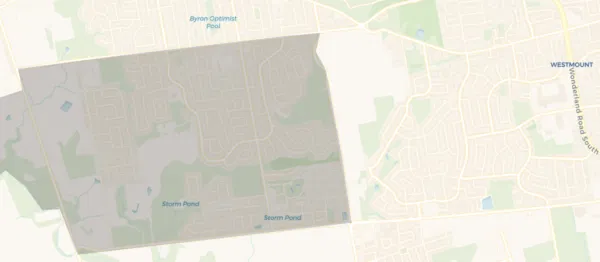
ne section of Byron London, in our MLS system, stated as South B.

The above is one section of Byron London, in our MLS system, stated as South B.

South B and South K cover the Byron neighbourhood. The commercial heart of the neighbourhood is at Commissioners and Boler, featuring a commercial corridor and a grocery-store-anchored shopping plaza.

The Byron core has:

  • a library,

  • a fire hall,

  • a legion,

  • a Masonic hall,

  • restaurants and dining,

  • professional offices,

  • medical and drugstores,

  • an LCBO,

  • jewellers, dry cleaners, and a few eclectic retailers.

Here is a link to Byron South B, including demographics, household types, schools, recreation, and much more you may want to know about a neighbourhood.

There is another commercial area at the intersection of Boler and Byron Baseline.

Byron South K

This part of Byron (South K) primarily consists of detached homes. Its population has remained stable, with 26% of households moving in the past 5 years and 8% in the past year. The area is mainly owner-occupied and has a mix of older and newer homes.

People & Families in South K

 Boler Mountain is a ski and mountain-biking area known locally as “the bump.” 

Experience the area’s natural beauty with various walking and biking trails. Springbank Park spans 300 acres along a stretch of the Thames River and features 19-plus miles of trails. Nearby are Komoka Provincial Park and the Warbler Woods Trail. 

Below covers the historical Byron London, Ontario, real estate market conditions for the years listed. For current market insights, updated stats, or expert guidance, contact me for a personalized analysis.


As of April 4, 2025, 55 houses had sold in Byron London, averaging 39 days on the market. Four apartment condos sold, averaging 76 days on the market; five townhouses and townhomes sold, averaging 17 days on the market.

The 2024 Byron London Ontario Real Estate Market

Houses Sold in 2024 185Apartment Condos Sold in 2024  21Townhouses/Townhomes Sold in 2024  47
Time on Market 28 days Time on Market  42 daysTime on Market 40 days
Price Range $399,900 – $2,125,000Price Range $350,000 -$887,500Price Range $379,500 – $925,000
% to Asking Price 99.36%% to Asking Price 98.05%% to Asking Price 97.86%

Byron London Ontario Real Estate Market Data from MLS London St.Thomas Association of Realtors (LSTAR)

Previous Years Byron London Ontario Real Estate Market Sold Prices

Sold is a great four-letter word for Byron London, Ontario Home Sellers

Houses Sold Year in 2023 184Apartment Condos Sold in 2023 23Townhouses/Townhomes Sold in 2023   62
Time on Market 24 daysTime on Market 26 daysTime on Market 21 days
Price Range $520,000 – $2,215,000Price Range $300,000 -$982,500Price Range $390,000 – $900,000
% to Asking Price 98.52%% to Asking Price 97.38%% to Asking Price 99.14%

Byron London Ontario Real Estate Market Data from MLS London St.Thomas Association of Realtors (LSTAR)

2022

  • In 2022, 180 houses in Byron, London were sold through MLS. The average number of days they were on the market before selling was 16, up 8 days from Spring 2022. These 180 houses in Byron sold for 109.25% of the asking price, ranging from $490,000 to $3,450,000. Eighteen apartment condos were sold, and the average days on the market were eleven. The average sold price was 108.98% of the asking price, with prices ranging from $299,000 to $1,211,000. Forty-five townhouses or townhomes sold within 15 days on the market. Sold prices ranged from $439,000 to $980,000, with an average of 110.15% of the asking price.

2021

  •   In 2021207 houses in Byron, London, Ontario, were sold through MLS. Averaging 12 days on the market and selling for 112.93% of the asking price. The low was $480,000, and the highest was $2,125,000! Twenty-two apartment condos in Byron exchanged hands, averaging 26 days on the market. These sold for 100.77% of the asking price. The low was $375,000, and the high was $835,000. The median price per square foot was $408.00. Sixty-three townhouse condos & townhomes sold through MLS, averaging eight days on the market. These sold for 113.23% of the asking price—the low was $341,000, and the high was $811,000.

2020

  • In 2020,  322 Byron houses and condos were sold through MLS. 239 houses sold, with the median days on the market being eight and selling at 103.69% of the asking price. Sold prices ranged from $380,000 to $1,650,000. Eighty-three condominiums sold in Byron, ranging from $225,000 to $930,000. These were 12 days on the market, and the median prices were 101.7% of the asking price!

2019

  • In 2019, 234 houses in Byron, London, Ontario, sold between $270,000 and $1.094,000. The median days on the market were 12, and the sold prices were 100% of the asking price! For townhouses, townhomes, and apartments in Byron, 77 sold from a low of $177,500 up to $640,000. The median selling price for condos in Byron was 102.35% of the asking price. These condos averaged 9 days to sell.

2018

  •   In 2018, 215 houses sold in Byron London, Ontario, for an average of $381,454- $103.22% of the asking price! These Byron houses took an average of 22 days to change hands. 61 Condominiums, including apartment condominiums, townhouses, and townhomes, sold for 105.46% of the asking price. The days to sell through MLS were 16, for an average selling price of $338,839!

  The Optimist Club of Byron is an excellent example of community volunteers.

good job Ty Lacroix

Testimonial About What Our Clients Say About Envelope Real Estate Group

Disclosure:

  • I am a Broker Realtor in London, Ontario

  • While stats are valuable, you would be wise not to base any financial decision on them alone. What sold yesterday or six months ago on your street or in your community is history and cannot be changed. The buyer's or seller's motivation two months ago or three years ago to make a decision, we cannot change.

whats your home worth

Read
This website may only be used by consumers that have a bona fide interest in the purchase, sale, or lease of real estate of the type being offered via the website. The data relating to real estate on this website comes in part from the MLS® Reciprocity program of the PropTx MLS®. The data is deemed reliable but is not guaranteed to be accurate.