RSS

The Brutal Truth About Real Estate As an Industry!

Consumers, Realtors, and Governing Overseers often overlook the brutal truth about real estate and what makes it tick!

For clarity, I am a Realtor in London Ontario and I am not perfect, yet after 20 plus years in this industry, most days I shake my head and ‘WTF’!

Below is a blog post by Marc Davison of 1000WATT, the most successful branding, marketing, communications, and design company in the real estate industry.

The Brutal Truth

Real estate loves its scoreboards. Deals closed. Units sold. Money earned. Rankings, awards, lists. We’ve made production numbers the default measure of worth, leaving little room for how the work is done and how people are serviced along the way.

Clients don’t measure greatness in numbers; they remember how they were represented. Yet, as an industry, we keep mistaking volume for value, selling success as a stat instead of a standard of care.

It’s time to…

Just stop

In branding, brand core defines a company’s center of gravity. For Volvo, it’s safety. Nike, performance.In real estate, production (sales) is our default.

We listed this. We sold that. We closed 40 deals in 45 days. We’re number one. We ranked in the top 1%. We hit $5 billion in volume. We had a record month. We acquired.

Same song. Different verse. Every time.

“Top Producer” has forever been the pinnacle badge of honor. Volume and transaction count are the only barometers of success, which makes sense if you are in the sales business. I’d like to believe that most of us think we’re more than that.

Meanwhile, what it takes to produce those numbers — the planning, the orchestration, the systems, the representation, the service — that story is absent from all marketing and communication.

While we often recite this line like scripture: “Real estate is the most expensive blah blah blah people will ever make,” the brutal truth is, no one believes it. Not the broker who says it, then hands deals to untrained agents. Not the consumer who’s heard it on endless repeat and ends up with one of those agents. The kicker is that the verse is a marketing tactic to generate more sales.

This mantra was likely crafted to elevate the profession, but it’s become background noise. If we truly believed it, and wanted the world to believe it, the message would be simpler and truer: Realtors are the single line of defense that protects people from a financial bloodbath. 

This isn’t the headline. It’s a truth that should drive everything we say and do, not through a “trust me, you need me” pitch, but in how we behave, communicate, market, celebrate, and prove real skill, representation, and protection in every transaction.

FAFO

But we don’t. And because we don’t, a seller decides to go at it alone, blind to the risks, one step from the FAFO zone, (“FAFO” is an internet slang acronym that stands for “F* Around and Find Out“**. It’s a phrase used to express that actions have consequences, often with a sense of schadenfreude when someone experiences negative repercussions for their choices. The phrase is a more polite version of the original, “F*** Around and Find Out ) and no idea what went wrong when she crosses it.

Here’s what she never sees:

  • The mistakes seasoned agents get ahead of before they blow up the whole deal.

  • The broker who boots an agent for crossing an ethical line.

  • The focus, grit, and saves that keep deals alive.

  • The billions spent to keep real estate safe, secure, and more transparent than almost any other financial transaction.

How could she see it? Our marketing makes sure she never does.

If we want the public to value real estate differently, the first step isn’t blaming consumers for misunderstanding us; it’s fixing what we communicate.

Clients still pay the fees. Many agents earn every dime. But even the best agents miss chance after chance to communicate real expertise and worth. I know I sound like a broken record, but damnit… that “Just Sold” postcard skips over everything that matters and markets what doesn’t: We sold something you can no longer buy.

Just stop.

Invisible value

Numbers matter.

If I’m on trial, I want the lawyer with courtroom experience. The more wins, the better, because in this context, winning is never a given.

That’s the difference. When a lawyer wins, the public connects it to skill. When a home sells, they don’t. They assume it would’ve sold anyway. Often, they’re right. The sale isn’t where the skill or value is. It’s in everything else this industry does up to the sale, the part we refuse to communicate.

Imagine a restaurant hanging its entire value on how many plates it served in a night and what it took in receipts. That’s how the real estate industry sounds.

Maybe this industry is so used to hearing itself that it doesn’t recognize how hollow the current story sounds. Or maybe it struggles to tell the right one.

It has to try harder.

Each time my agency digs beneath a client’s production numbers, we find buried value that they never communicate. Systems. Judgement. Protection. Beliefs. Representation of the highest caliber. Things that make production almost irrelevant.

In a market this tight and an economy this uncertain, with inventory shrinking and AI pressing into every corner of what this industry thinks defines its worth, not telling your better story is more than a missed opportunity, it’s a wasted advantage.

That’s the brutal truth. I know you can handle it.

Copyright © 2025 1000WATT, All rights reserved.


Note: I have added the pictures and the definition of FAFO from Google

Ty Lacroix Broker

Read

What Is Stalling London Ontario Home Sales?

What is stalling London Ontario home sales and how you can take advantage of this market, be it a buyer or a seller!

BMO Capital Markets has been transparent about what is holding back the real estate market: the spread between what sellers want and what buyers are willing to pay.

At the bottom of this blog, I will articulate the best I can how this will affect you if:

  • You don’t care what the market does.

  • You are thinking of selling.

  • You are thinking of buying.

  • You are thinking of buying and selling.

  • Your home is for sale now.

Robert Kavcic, senior economist, describes it as a “wide bid-ask spread” that has prevented the market from clearing, leaving listings to languish. The only durable remedy is to close that gap.

There are three theoretical ways to achieve it.

  • The first is forced selling, which would require a deep recession, rising defaults, and job losses, a scenario neither imminent nor desirable.

  • The second is a substantial drop in mortgage rates into the low three-percent range, requiring a cut of roughly 100 basis points from current levels. That path is considered improbable in the near term.

  • The third is price reductions. BMO regards this as the most realistic outcome. RBC reaches a similar conclusion, noting that moderating prices in several regions have delivered the most remarkable affordability improvement in three years, encouraging more buyers to act.

 Price Movements Are The True Lever Of Affordability

In the current interest rate environment, the arithmetic of affordability favours price declines over marginal rate cuts. Consider a $700,000 home with 20 per cent down, a 25-year amortization, and a five per cent mortgage rate. A five per cent drop in price reduces monthly payments by approximately $165. By comparison, a 25-basis-point rate cut on the same home saves about $58 per month.

The implication is straightforward: in the near term, further moderation in prices will have a greater influence on unlocking demand than incremental moves by the Bank of Canada.

Daniel Foch wrote: “September’s influx of new listings will test the market’s resolve. CREA (Canadian Real Estate Association) highlights this as a pivotal moment, when the balance between buyer demand and seller supply could either sustain recent gains or compel further price concessions.”

He further wrote: “The outcome matters because the recent lift in sales reflects opportunity rather than exuberance. With mortgage rates still high, price adjustments have been, and will remain, the most powerful lever for unlocking demand. In many major markets, values have eased just enough to restore a measure of affordability, drawing sidelined buyers back into the fold. “

How This Will Affect You

You Don’t Care What The Real Estate Market Does.

The real estate market affects everyone, from tenants and landlords to developers, as well as the commercial and industrial workforce, and affordability. Even if you have no intention of buying or selling, your wealth or poverty status is irrelevant. You don’t have to guess what drives interest rates, population growth or decline or demographics.

Reality is neutral.

You Are Thinking Of Selling.

You have two choices: price to sell or price to sit.

Thinking Of Buying.

The smartest move in a London, Ontario Buyer’s market is to buy now! 

You Are Thinking Of Buying And Selling.

What you can buy for and sell for is the spread, a few synonyms: unfurl, broaden, expand, proliferation, advance and reach your net worth!

Your Home Is For Sale Now.

Your pricing strategy will make or break your results. And no matter the market—sellers, buyers, or balanced—every seller has just three choices:

  1. Price At the Market

  2. Price Behind the Market

  3. Price Ahead of the Market

What are the consequences?

Wondering What To Do?

Sell, buy, stay, sit, guess?

Allow me to help you understand the London Ontario real estate market


Read

Low-Ball Offers in London Ontario Insult or Opportunity?

If you’re selling your home, there’s nothing quite like the gut punch of low-ball offers in London Ontario. You’ve priced your property carefully, it’s beautifully presented, and then—wham!—someone tosses out a number that feels like an insult.

Here’s the thing: low-ball offers happen, especially in a buyer’s market. They can be frustrating, but they don’t have to be deal-breakers. With the right strategy (and the right Realtor), a low offer can become the start of a real negotiation, not the end of it.

What Exactly Is a Low-Ball Offer?

Pretty much what it sounds like: an offer significantly below your asking price, typically 10% to 20% lower, or more.

Why do buyers do it?

  • They want a deal.

  • They’re testing your flexibility.

  • They simply want to see if they can get lucky.

Low-ball offers often come with “sweeteners” to make them look more appealing:

  • Cash offers for a quick close.

  • Fewer conditions (waiving inspections or appraisals).

  • Repair requests or credits to justify their price.

From a buyer’s perspective, it’s just strategy, or in 90% of the time, false perceptions! For a seller, it feels personal. But it doesn’t have to be.

A Real-World Example

You list your home for $800,000—priced right for the market, in great condition, desirable neighbourhood. Then someone offers $700,000.

Why would they do that?

  • Market conditions give them the confidence to push.

  • They see (or invent) flaws to justify a discount.

  • They’re hoping to “meet in the middle.”

  • They love the house but simply can’t afford the full ask.

The Realtor Factor

Here’s what most sellers don’t realize: In many deals, it’s not the buyer or the seller who derails negotiations. It’s the Realtors.

Every offer gets filtered through two people: the buyer’s agent and the seller’s agent. If one of them lacks skill—or lets ego take over—the deal can implode before it has a chance.

A skilled negotiator knows how to:

  • Read the other agent’s style without getting rattled.

  • Keep communication productive, not personal.

  • Turn a bad offer into a constructive conversation.

This is not the picture your Realtor uses on her Facebook pages

Unfortunately, not all Realtors are skilled negotiators. In fact, I’d say most aren’t.

The Five Realtor Types (and How They Can Sabotage a Deal):

  1. The Ghost – Disappears when it’s time to talk numbers.

  2. The Bulldog – Pushy, combative, and thinks “winning” is the point.

  3. The Rookie – Nervous, inconsistent, and overly reliant on scripts.

  4. The Bluffer – Creates false urgency, bends the truth.

  5. The Performer – Loves the drama more than the deal.

After selling hundreds of homes in London and the area, I’ve seen them all. Most low-ball offers in London Ontario and anywhere come from agents who haven’t done their homework—or believe they’re “King Sh*t” because low-balling worked once before.

Try educating them with real data and comparable sales, and you often get dismissed. Ego trumps facts.

And here’s the reality: no amount of staging, marketing, or drone videos can save you if your Realtor can’t negotiate.

How Sellers Can Protect Themselves

  1. Expect low-ball offers—they’re part of the game.

  2. Don’t take it personally—the first offer is rarely the last.

  3. Hire a Realtor who understands negotiation theory, not just sales tactics.

Numbers don’t lie. But how those numbers are presented—and defended—makes all the difference in whether you sell for a price you’re happy with.

Thinking About Selling Your Home in London, Ontario?

If you want more than just a sign on the lawn—and you want someone who can actually handle the messy part of real estate (negotiations)—let’s talk.

What Will Buyers Pay For Your Home?

Read

Top Reasons Home Buyers Won’t Offer!

You might be surprised at the top reasons homebuyers won’t offer on a home. The scariest part is sometimes before they’ve even stepped inside!

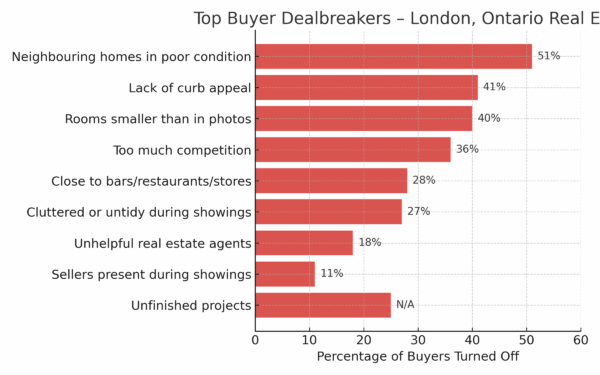
A recent Leger survey asked over 1,500 Canadian buyers and sellers what would make them pass on a property. The results reveal dealbreakers that could cost London home sellers showings, offers, and ultimately, their sale price.

Buyer Turn-Offs: Reasons Home Buyers Won’t Offer

  • Neighbouring homes in poor condition — 51% said this would kill a deal instantly.

  • Lack of curb appeal — 41% won’t even get out of the car.

  • Room sizes are smaller than in photos — 40% feel misled.

  • Too much competition — 36% get discouraged and walk away.

  • Close proximity to bars, restaurants, or stores — 28% see this as a negative.

  • Cluttered or untidy during showings — 27% can’t picture themselves living there.

  • Unhelpful real estate agents — 18% leave with a bad taste.

  • Sellers present during showings — 11% feel uncomfortable.

The Silent Killer: Unfinished Projects
Nothing screams “neglect” like half-painted walls, uninstalled trim, or incomplete flooring. Buyers don’t just see the unfinished work — they see future headaches and extra costs. Before you list, wrap up every project, even the small ones.

 Buyers of a house or a condo have a lot of things on their minds, be it financing or finding the right place. Anything else that frustrates home buyers is not going to help you sell. They do not need more reasons not to make an offer

Why This Matters for Sellers
In today’s competitive London Ontario real estate market, buyers have options. If your property raises even one red flag, they’ll simply move on to the next home. But with the right preparation and marketing, you can position your home as the one they want.

Now, If None of The Above Are The Reason, Then Why No Offers?

The Brutal Truth? Price!

Price is not a dirty five-letter word; sold is one of the best four-letter words in the realm of real estate

 London and Area Home Sellers: You Only Have 3 Pricing Strategies — Which One Are You Choosing?

❌ 51% of buyers… gone.

What’s the #1 thing that makes buyers walk away from a London home?
(Hint: it may not be price.)

Let’s make sure YOUR home isn’t guilty.


Read

The Smartest Move in a London Ontario Buyer’s Market

The smartest move in a London, Ontario Buyer’s market is to buy now! When the real estate market tips in favour of buyers, opportunity is everywhere. More choice. More negotiating power. Less competition. Yet oddly enough, instead of seizing the moment, many would-be buyers do… nothing.

They’re not buying homes. They’re buying into negative headlines and half-baked advice.

Think about it:

  • In a seller’s market, buyers were tripping over themselves to bid on homes—sometimes paying well above asking—because they feared missing out. The advantage was firmly with the seller, yet buyers dove in headfirst.

  • In today’s buyer’s market, the tables have turned. Prices are softer. Conditions are negotiable. It’s easier to get exactly what you want. But now? Buyers are hesitating, worried they’ll “pay too much” if prices slip further.

It’s the ultimate market irony: when fear should have been high, buyers felt fearless. Now that fear should be low, buyers freeze.

Here’s the truth—you’ll only know the exact bottom of the market once it’s already passed. The same goes for the top. Wait too long, and you’ll miss the sweet spot entirely.

In my experience, the smartest buyers in London, Ontario, right now are not reckless or greedy. They understand the market. They’re strategic. They see the bigger picture and act while the advantage is theirs.

Capable Buyers

Capable buyers are often paralyzed by the sheer volume of information, much of which is incorrect, the numerous choices available, and the numerous opinions. This leads to confusion and prolonged waiting, as they fear making a mistake.

Too many capable buyers get stuck in “analysis paralysis”—drowning in conflicting media stories, well-meaning but unqualified family advice, and outdated assumptions. The result? They wait. And wait. And wait… until the market shifts again, and opportunity is gone.

The fact is, market expectations are often more emotional than factual. If you want to make a confident, well-timed move, talk to someone who’s on the front lines every single day, not just speculating from the sidelines.

Bottom line:

This is a fantastic time to buy in London and the area—if you have the right information. As an experienced local Realtor, I’ll make sure you have the facts, the strategy, and the advantage.

Read

Smart London Home Buyers Don’t Just Offer Less. They Offer Better.

Smart London Ontario home buyers know how to make an offer that wins, without low-balling!

When you’re buying a home in London, Ontario, it’s tempting to start with a “throwaway” offer—something low, just to see what happens.

But here’s the risk:

  • Sellers can dismiss your offer outright.

  • A skilled seller’s agent can expose your lack of preparation (and make you look unserious).

  • You lose credibility with the other side.

  • And sometimes, you lose the house you actually wanted.

Strong offers aren’t always about price—they’re about strategy. That means:

  • Using data to justify your number.

  • Structuring terms that appeal to the seller.

  • Having a Realtor who knows how to negotiate without burning bridges.

“Most deals don’t fall apart because of buyers or sellers—they fall apart because of Realtors who don’t know how to negotiate. Here’s how low-ball offers actually reveal who’s skilled, who’s guessing, and how to protect your price.”

Every offer is filtered through two people:

  • The buyer’s agent (who frames the property’s value).

  • The seller’s agent (who protects it).

If one of them lacks skill—or lets ego drive the conversation—the deal can collapse.

A strong strategic offer or a low ball offer, what is your Realtor advocating?

Five Realtor Archetypes That Sabotage Deals

  1. The Ghost – Disappears or gives vague responses.

  2. The Bulldog – Pushes hard but forgets the goal is an agreement.

  3. The Rookie – Nervous, inconsistent, overly script-driven.

  4. The Bluffer – Creates false urgency or twists facts.

  5. The Performer – Loves drama more than results.

After helping hundreds of home buyers and sellers in London, Ontario, I’ve learned this: the right Realtor isn’t transactional, they are transformational, they’re your shield, strategist, and negotiator.

Smart London home buyers understand the difference between price and value and do not confuse the two!

Ready To Start Looking?

Let’s put a strategy in place before you fall in love with the right home.

See how we can help

Read